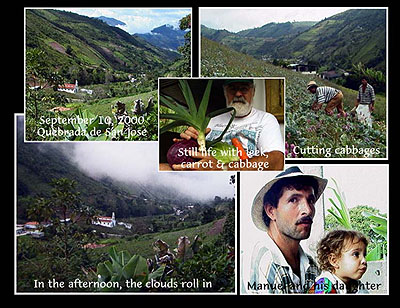
This morning after much discussion, we finally get ready to go and
visit Rosa's sister Candida and her husband Manuel who live in the Quebrada
(canyon) de San Jose near La Grita. We had planned to leave here by
8 or 9 but actually left at 10 or so. Freddy & Rosa, their kids and
Fernanda went with us. We had to stop in Seboruco to leave the beer
bottles from the other night and do a couple more errands. Then we continued
on out of town to La Grita where we went to the newly opened internet
caf� there to get our e-mail. We were there right at noon.
We headed out a street near the soccer field and crossed one of the
small suspension bridges that dot the countryside here and start up
a small road at the bottom of a steep canyon that is lined on both sides
by small farms. We wind and wind though many curves at the bottom of
the quebrada and I get nervous because I know at some point, we will
have to climb out of the canyon which will mean a steep ascent. I remember
with horror a repeat from the other day when we stalled out on the mountain
road to Santa Clara.
The quebrada opens up somewhat and there are pretty farms all along
the steep hillside where cole crops like cabbage and cauliflower grow.
Finally we arrive at a place where they tell me to turn left down a
steep drive. We do and immediately come to a fast flowing stream that
has to be forded. On the other side is a very steep ascent around a
curve. I slowly cross the stream and then give the Vanagon full gas
for the ascent but as I feared, we stalled out. We unloaded the 800
pounds of passengers we had and I drifted back to a somewhat level driveway
just out of the creek. Will thinks I can make it through so I re-cross
the creek, turn around and try it again. This second time, I do make
it up the first incline. Then, you go between a potato field and an
onion field up to the edge of the steep mountainside which had a concrete
road climbing it. Kai with his automatic transmission made it OK. At
the bottom of the drive is a ditch that has to be crossed slowly. Once
across, I give it full throttle for the 300' long steep incline. Some
290' up the road, the engine loses all power and dies. As usual, I hate
to be in the position I now find myself in... dead engine still dripping
water, impossible incline, no way to easily back down with no power
and no way to leave it safely where it is. Tractor boy Will who, at
home, steers our tractor up the road with both front wheels off the
ground using only the rear brakes, takes over.
We try to restart the engine but the fuel pump refuses to run. Kai
and Will want to figure out the problem here and I want to get back
down off this slope. Will has to coast the Vanagon off in reverse slipping
the clutch coasting into another driveway at the bottom where the front
bumper scrapes the ground as he goes in and again as the van rocks precariously
on the way out. He coasts it back to the stream where there is a concrete
driveway so he coasts in and parks. We look at the fuel pump and fuses
and without doing anything, it starts to work again. Will leaves to
walk up the hill to the house and I sit quietly for a time to calm down
enough to see people.
Finally I walk up the drive after taking some pictures of some flowers
outside the house of a Maracucho (person from Maracaibo) who comes here
only on weekends. The house of Manuel and Candida is perched, as are
almost all houses here, on the mountainside overlooking the valley below
and the sheer steep incline of the quebrada on the opposite side. There
are farms in each direction as far as you can see -- all on more than
a 45 degree slope up from the creek. Papas, zanahoria, cebolla, cebolline,
ajo porro, ajo, aji all grow here. (Potatoes, carrots, onions, green
onions, leeks, garlic, peppers). All the fields are worked by hand and
they are all well cared for. We sit on the porch and take in the view
which is stupendous. Down the valley to our right are other identical
farms. We can see a small church on the valley floor.
Papas sell for up to Bs. 12,000 (bolos for short-Bs is the abbreviation
for Bolivares) a sack, carrots between Bs 4,000 and 12,000 a sack although
perfectly good carrots that are too small or too large (I saw one that
weighed several pounds!) are sold for Bs 1,000 a sack ($US 1.48) to
feed the cows and pigs. Cabbage (repollo) sells for Bs 1,000-5,000 a
sack although now there is a glut of cabbage so it sells for Bs 500
a sack. They have a cabbage field which has beautiful full heads of
cabbage which they are going to let stay in the field since they are
not worth harvesting.
We have some beer and some miche and watch the clouds slowly lower
and cover the tops of the surrounding mountains. Candida makes a green
drink of berros (watercress) and milk that is supposed to be good for
the stomach. It tastes pretty good. The whole time we have been there,
Rosa and Candida have been in the kitchen fixing a hervido which is
a stew of vegetables and meat all cooked on a wood stove that is built
into the corner of every kitchen which, incidentally, also has a propane
fed gas stove.
Finally late in the afternoon the stew is ready and we go to eat.
It is good and like everything else here tastes of cilantro. As the
clouds lower and the sun sets behind the wall of the quebrada, we realize
that the drive back will be after dark�a horrible thought here in Venezuela
where there are almost no road signs, no white lines in the center or
along the edge, no markers for where the road is washed out or has slipped
over the side of the hill, where everyone uses high beams and refuses
to dim them or worse uses no headlights at all, where people walk two
abreast along the roadside knowing that they can see you and not realizing
that you can't see them, where motos and bicycles glide along the edge
of the road, where speed bumps hide in the shadows ready to jar loose
every screw and bolt in the car!
Of course, since we are equivalent to 'a bus' today for Freddy and
Rosa who don't get here too often, Manuel and Candida get sacks and
fill them with produce for us to haul back. We probably have at least
200 pounds of carrots, cabbage, leeks, onions and other things that
grow there. A nice gesture were it not for the fact that we already
had a full vanload of passengers.
We make our way slowly back through the darkness without falling in
a hole. Three rules about driving in South America: Don't drive at
night! Don't drive at night! Don't drive at night!